Program Train the Trainer

590,00  (fără TVA)

Payment will be made after registration is confirmed. One of our colleagues will send you payment details by email.

October 5-14, 2026

About the Train the Trainer Program

What it is not?

It is not a theoretical course on learning styles, nor is it a “paper-only” certification obtained with your camera turned off. It does not provide you with a set of pre-made, copy-paste methods, and it does not promise that you will become a fully-formed trainer in four weeks.

The program sets itself apart through the ratio between practice and duration: every topic concludes with an applied exercise on your own session, and what you take home is a tested deliverable, not just a notebook. The pace is sustained and involves individual work between meetings.

The Train the Trainer program is for you if

  • you have started delivering training — or are about to start — and you want a solid foundation, not just courage
  • you already have delivery experience, but you feel like you are repeating the same methods and need methodological refinement
  • you are a specialist in a field and you are increasingly asked to “teach others”, without having the tools of a trainer
  • you need ANC certification, but you do not want a course where you just check off attendance
  • you want honest feedback on how you deliver, in a small group and in a safe setting

590,00  (fără TVA)Add to cart

Program map and trainer

WHO I AM

Your identity as a trainer, the principles of adult learning, the analysis of the group’s needs.

WHAT I BUILD

Learning objectives, session architecture, choice of methods, learning assessment.

HOW I DELIVER

Presence, facilitation, questions and debriefing, group dynamics, adaptation for online.

Learning objectives

General objective

By the end of the program, participants will be able to design, deliver, and evaluate an adult training session
in both face-to-face and online formats, consciously taking ownership of their own training style.

Specific objectives

By the end of the program, participants will be able to:

1. Analyze the training needs of a target group and translate the findings into design decisions.

2. Formulate observable and measurable learning objectives aligned with the target level of complexity.

3. Design the architecture of a 90-minute session with alternating methods and explicit moments of knowledge transfer.

4. Select and apply at least five active training methods tailored to the objectives and the group.

5. Deliver a training segment demonstrating presence, clear instructions, and effective time management.

6. Conduct a debriefing of an activity using questions that lead to meaning and practical application.

7. Manage group dynamics and difficult situations through assertive, non-defensive interventions.

8. Give and receive structured, descriptive, and actionable feedback.

9. Build learning evaluation tools aligned with session objectives.

10. Adapt a face-to-face session for online delivery while maintaining the level of interaction.

11. Self-evaluate their delivery using a structured grid, compare their self-evaluation with received feedback, and build a personal development plan.

Program structure

Stage 1 — ONLINE: The Foundation (2 sessions of 3 hours each)

Online Session 1: The Trainer in the Mirror – Role, Style, and Adult Learners

Who you are as a trainer and what we know about how adults learn.

At the end, participants will be able to:

  • recognize their own trainer style, strengths, and risk areas.
  • explain the principles of andragogy and mechanisms from neuroscience with a direct impact on design (attention, emotion, active recall, spacing).
  • analyze the training needs of a real target group within their own context.

Online Session 2: From Need to Objectives – Designing a Meaningful Session

Translating need into objectives, and objectives into structure and methods.

At the end, participants will be able to:

  • formulate observable and measurable learning objectives
  • build the structure of a 90-minute session: opening, content, application, transfer, closing
  • choose methods suited to the objectives rather than personal preferences

Deliverable between stages: The first draft of your own 15-minute session, which will be tested in the lab.

Stage 2 — FACE-TO-FACE: The Laboratory (2 days, 4 sessions of 90 minutes per day)

Day 1 — Presence and Method

Session 1. Presence and Credibility

Voice, body, space, and emotions before starting.

At the end, participants will be able to:

  • consciously use voice, pauses, pace, and spatial positioning
  • apply two emotion-regulation techniques before and during delivery

Session 2. The Opening That Engages the Group

Learning contract, psychological safety, the first 15 minutes.

At the end, participants will be able to:

  • lead an opening that sets objectives, ground rules, and a safe atmosphere
  • manage diverging participant expectations

Session 3. Active Methods Portfolio

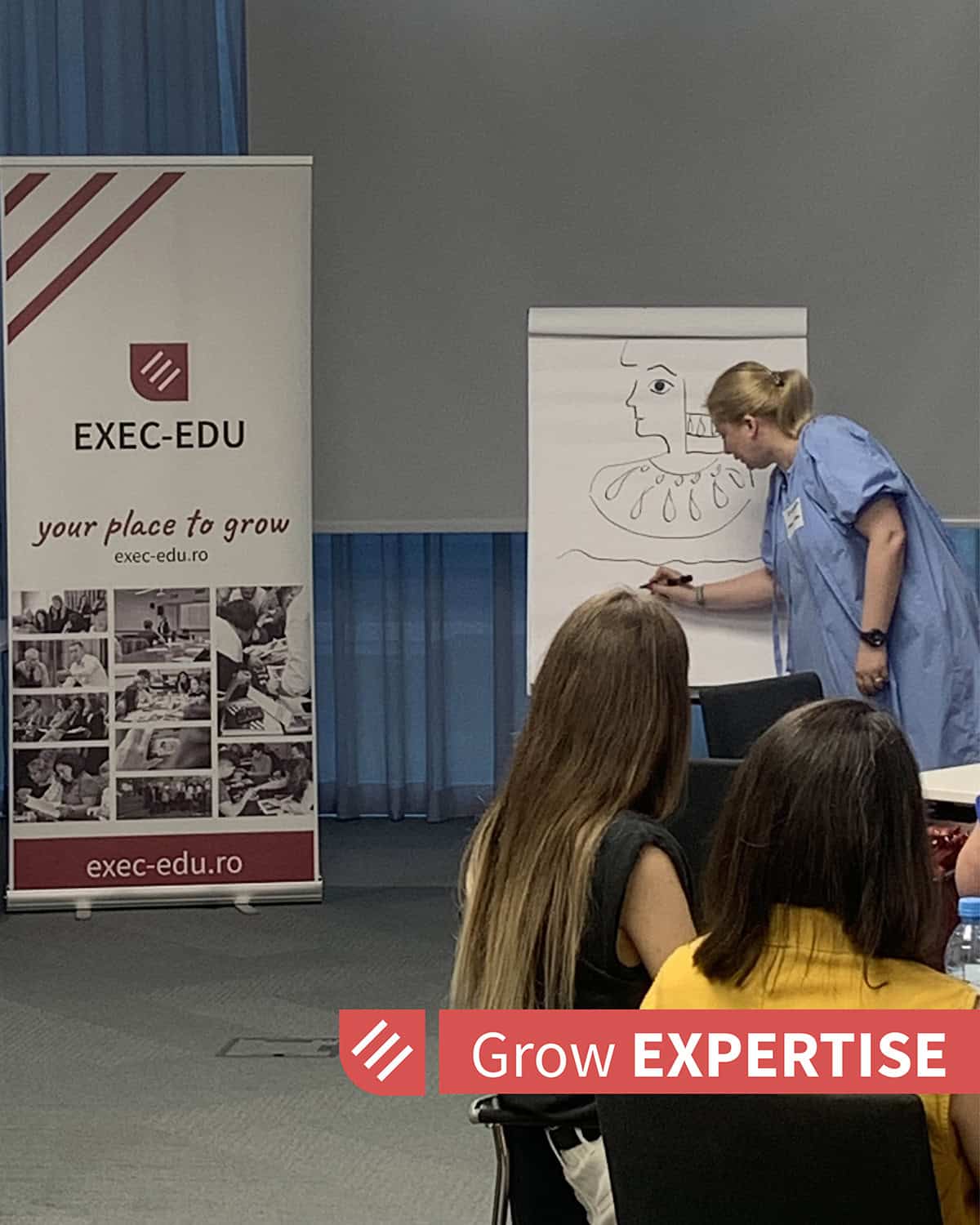
Case study, roleplay, simulation, small group work, gamification elements. Also includes a short demonstration of visual aids and graphic facilitation presented as a complementary method.

At the end, participants will be able to:

  • choose the right method for a given objective and justify the choice
  • formulate clear, verifiable instructions for at least three active methods

Session 4. The First Mirror: Micro-Delivery and Feedback

Short deliveries in parallel small groups with an observation grid.

At the end, participants will be able to:

  • deliver an 8–10 minute sequence from their session
  • provide criteria-based descriptive feedback and integrate received feedback into a concrete revision

Day 2 — The Group and Learning

Session 5. Facilitating Learning: Questions and Debriefing

The moment an activity turns into learning.

At the end, participants will be able to:

  • conduct a 4-step structured debriefing (What happened? How did I feel? What does it mean? What do I do tomorrow?)
  • use open questions and silence as facilitation tools

Session 6. Group Dynamics and Challenging Moments

Resistance, conflict, dominant or withdrawn participants, time overruns.

At the end, participants will be able to:

  • identify types of difficult situations and select the appropriate intervention
  • respond to objections without getting defensive or making excuses

Session 7. Evaluating Learning

What we evaluate, how we evaluate, and what we do with the results.

At the end, participants will be able to:

  • build evaluation tools aligned with objectives (observation grid, practical test, questionnaire)
  • explain the levels of training evaluation and their limits

Session 8. THE LAB: Delivery and Feedback

Delivering your own session in parallel small groups, with role-based observers: content, instructions, presence, time.

At the end, participants will be able to:

  • deliver a complete 15-minute sequence with objective, method, and debriefing
  • self-evaluate before receiving feedback, integrate group observations, and state three refinement decisions

Stage 3 — ONLINE: Virtual Delivery, Portfolio, and Certification (2 sessions of 3 hours each)

Online Session 3: Online Trainer + Certification Test Preparation

Adapting the session for virtual environments and finalizing the portfolio.

At the end, participants will be able to:

  • adapt a face-to-face sequence for online delivery while maintaining interaction levels
  • use engagement tools (breakout rooms, collaborative boards, polls, chat) with clear instructions
  • finalize their portfolio and understand the exam structure and criteria through a short simulation.

Online Session 4: EXAM with the Certification Board + Check-Out

Theoretical test and defense of the training project before the committee, followed by program closure.

At the end, participants will be able to:

  • demonstrate occupational standard competencies to the examination board.
  • formulate a personal trainer development plan for the next six months

An international consultant, trainer, and facilitator with over 17 years of experience in more than 15 countries (Romania, Zimbabwe, Senegal, Colombia, Bangladesh, Germany, Tajikistan, and others), Andreea Buzec designs and delivers training programs for UN agencies (UNICEF, UNV, ILO), the European Commission, private companies, and non-governmental organizations.

She specializes in intercultural communication, conflict management, learning design, gamification, participatory processes, and making educational content accessible.

Andreea Buzec

Investment

Program Train the Trainer

October 5-14, 2026,
October 5-6 – online sessions
October 8-9 – in the classroom
October 13-14 – online sessions
Where – hybrid course (myHive S-Park, Strada Tipografilor 11-15, Building A, Bucharest and online)

€590

For CAFFPA authorized courses, VAT is not applied to the registration fee, according to OG 129/2000 and L163/2005.

Exam fee: 50 EUR

590,00  (fără TVA)Add to cart

*If you participate with a colleague or friend, you receive a 10% discount.
**If you are a graduate of other EXEC-EDU programs, contact us for a personalized offer.

What do I get from this program?

1. A designed, delivered, and refined training session — not a concept, but a tested deliverable

2. An assumed training style, with strengths identified and put to work

3. An applied set of facilitation methods, with clear criteria for choosing between them

4. Design and evaluation tools that you use immediately, in your professional context

5. ANC Certification – Trainer (COR 242401), recognized in the European Union

6. Access to the “IN OGLINDĂ” professional community and its resources

590,00  (fără TVA)Add to cart

FAQ

It is EXEC-EDU’s train-the-trainer program, built as a workshop-lab, not a traditional course. The name comes from the idea that a trainer rarely gets the chance to truly see themselves: how they are perceived, what they convey, how they manage the group and unexpected moments. Here you deliver, then watch yourself, receive empathetic yet precise feedback, and learn to make conscious decisions in front of the group rather than automatic ones. The program is based on the ATD Training Delivery & Facilitation model and includes graphic facilitation, learning design, gamification, coaching, online adaptation, and content accessibility.

Not necessarily. The program is built for those at the beginning of their training career as well as for those who have already delivered sessions and feel the need for clarity, a personal style, and methodological refinement. It is also a good fit for in-house trainers at companies who want to practice and develop their skills. You come for the know-how, but also for the interaction with other trainers.

At the end of the program you take an exam and receive the Trainer certification issued by CAFFPA under COR code 242401, recognized nationally and across the European Union. This is the certification that allows you to be officially involved in training projects.

Yes. The program is specifically built for beginners as well, not only for experienced trainers. You start from your own trainer identity and style, build your own session step by step, and practice it in a safe environment with feedback. By the time you reach the final exam you are prepared, because you have tested everything along the way rather than just listened to theory.

You build it during the program. You choose your topic, and the program guides you from idea to structure to delivery, until you present your session in the lab, with filming and feedback. You don’t need to come with something ready; you come with a direction and leave with a tested and refined session.

No. Graphic facilitation is not about artistic talent, but about a few simple techniques that make your flipcharts and slides clearer and easier to remember. You learn them step by step and receive materials and examples to start from. Many participants who thought they couldn’t draw leave pleasantly surprised by what they can do.

They are serious moments, but not intimidating, because you arrive at them prepared. In the lab you deliver your own session in front of the group, you are filmed and receive feedback, and at the end you take an exam that confirms your trainer competencies. The entire journey, with rehearsals and refinement, is built precisely so you reach that point with confidence.

Between sessions you work on your own session and visual resources, reflect using the journal, and practice what you have learned. It is a manageable effort, spread across the roughly two months of the program, but it is worth setting aside a little consistent time, because it is precisely the work between meetings that turns theory into real skill.

You leave with more than a diploma. You have a fully tested, filmed, and analyzed session of your own, a real portfolio, visual resources you created, the “IN OGLINDĂ” reflection journal, and a personalized development plan. You also receive access to a digital library of methods, worksheets, and examples, and you join the “IN OGLINDĂ” community, with open practice, peer feedback, industry updates, and collaboration opportunities on projects.

How do I sign up?

590,00  (fără TVA)Add to cart

Do you have any questions?
Don’t hesitate to call us or write to us via chat, email or by filling out the form on the contact page.

Nivel

Specialist

Trainer

Andreea Buzec

Categorie

Grow Expertise

Updating
  • No products in the cart.
CALENDAR